Buying Guide India
Electronics starter kit India: what students should buy first and what to skip
A good electronics starter kit should help you learn debugging, power, wiring, inputs, outputs, sensors, communication, and project reliability. Most beginners waste money by buying random modules before they own the tools needed to diagnose them.
Direct answer
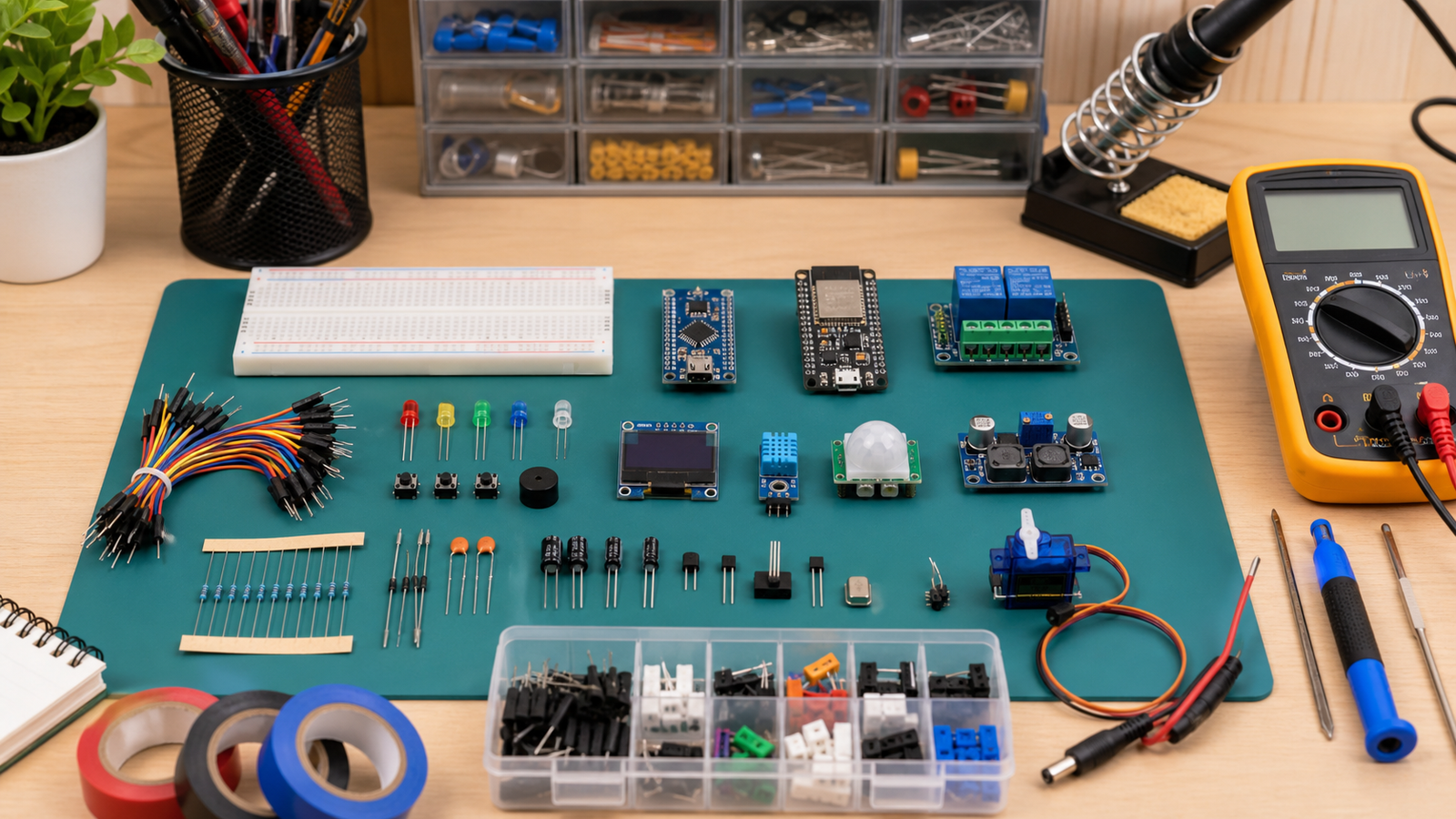
Indian electronics beginners should buy a multimeter, breadboard, jumper wires, resistors, LEDs, buttons, capacitors, Arduino Nano or Uno, ESP32 DevKit, basic sensors, OLED display, relay module, buck converter, 3.3V/5V power modules, and connectors before buying complex GSM, camera, LoRa, or high-power modules.
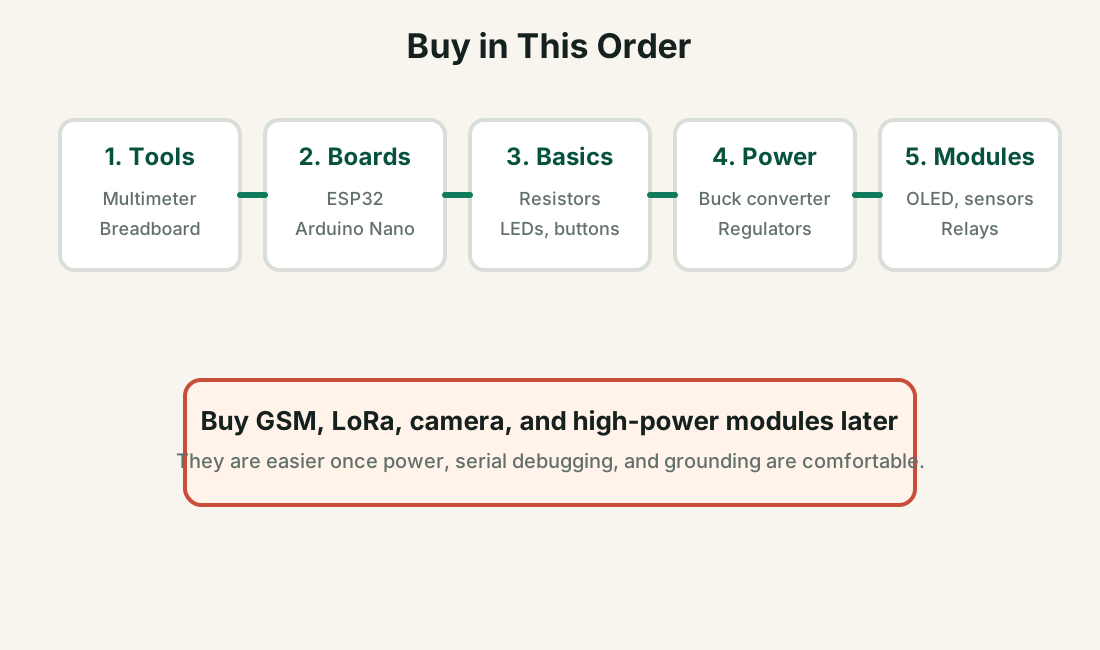
Buy in the right order
Do not begin with a huge sensor kit. Start with the parts that let you test and debug everything else.
Starter kit budgets in India
| Budget | Best for | What to include |
|---|---|---|
| Low budget | Absolute beginners | Multimeter, breadboard, jumper wires, LEDs, resistors, buttons, Arduino Nano clone, USB cable |
| Balanced starter | Students building real projects | Everything above plus ESP32 DevKit, OLED, relay module, DHT22/BME280, HC-SR04, LDR, buck converter, connectors |
| Serious maker | IoT and prototype builders | Balanced kit plus soldering iron, heat shrink, screw terminals, logic level shifters, spare regulators, sensor assortment, small tools |
Must-have parts and why they matter
Tools
- Digital multimeter
- Soldering iron and solder
- Wire stripper or cutter
- Small screwdriver set
Core boards
- Arduino Nano or Uno for basics
- ESP32 DevKit for Wi-Fi/Bluetooth projects
- Good USB data cables
- Breadboard power module or safe external supply
Basics
- Resistor kit
- LEDs and buttons
- Capacitors
- Potentiometers and buzzers
Useful modules
- OLED I2C display
- Relay module
- DHT22 or BME280
- HC-SR04 ultrasonic sensor
What to skip at first
- Huge mixed sensor kits: many modules are low quality, poorly documented, or rarely useful.
- SIM800L/GSM modules: useful, but frustrating until power and UART debugging are comfortable.
- ESP32-CAM: cheap and popular, but power, upload wiring, and camera debugging can distract beginners.
- LoRa modules: better after basic SPI, antennas, regulations, and range testing are understood.
- High-power motor projects: wait until you understand current, flyback, drivers, and safety.
Buy parts that teach reusable skills. A multimeter teaches more than five random modules you cannot debug.
Projects this starter kit should support
- LED, button, buzzer, and potentiometer basics.
- Temperature and humidity monitor with OLED display.
- ESP32 Wi-Fi sensor dashboard.
- Relay-controlled low-voltage load.
- Distance measurement with HC-SR04.
- Simple data logger or serial debug project.
- Breadboard-to-PCB practice project once the circuit is stable.
How this becomes a productization path
Once a project works on breadboard, the next challenge is reliability: stable power, connectors, test points, enclosure, BOM, and PCB layout. That is why PCBVault connects starter kit learning to breadboard-to-PCB and project review workflows.
FAQ
Should beginners in India buy Arduino or ESP32 first?
Arduino Nano or Uno is easier for simple basics. ESP32 is better for Wi-Fi, Bluetooth, IoT, and advanced projects. Many students should eventually own both.
What is the first tool an electronics student should buy?
A basic digital multimeter. It helps diagnose voltage, continuity, polarity, bad wires, and many common beginner mistakes.
Is an electronics starter kit enough for final-year projects?
It is enough to learn and prototype, but final-year projects often need better power planning, connectors, enclosure thinking, documentation, and sometimes a PCB.
Should I buy a soldering iron immediately?
Yes, if you want projects to survive beyond breadboard demos. Even basic headers and connectors often need soldering.
Want the checklist version?
The free Electronics Project Rescue Pack includes a starter buying checklist, module debug flow, power checklist, and breadboard-to-PCB readiness checklist.
Get the free rescue pack